
Experiment #1: Why Morning Light Matters

Updated: Sep 1

You wake up, reach for your phone and begin the day indoors. Perhaps you make coffee, shower, prepare breakfast and answer a few messages before leaving the house. If you work from home, it may be several hours before you go outside at all. By then, you have been awake for half the morning, yet your eyes have mostly encountered the relatively dim light of a bedroom, bathroom and kitchen.
I have become more aware of this in my own morning routine. It is easy to think of daylight as something we happen to encounter once the day is underway. From the perspective of the body, that light is part of what starts the day. Opening the curtains helps, although stepping outside creates a much stronger signal, including on a grey morning.
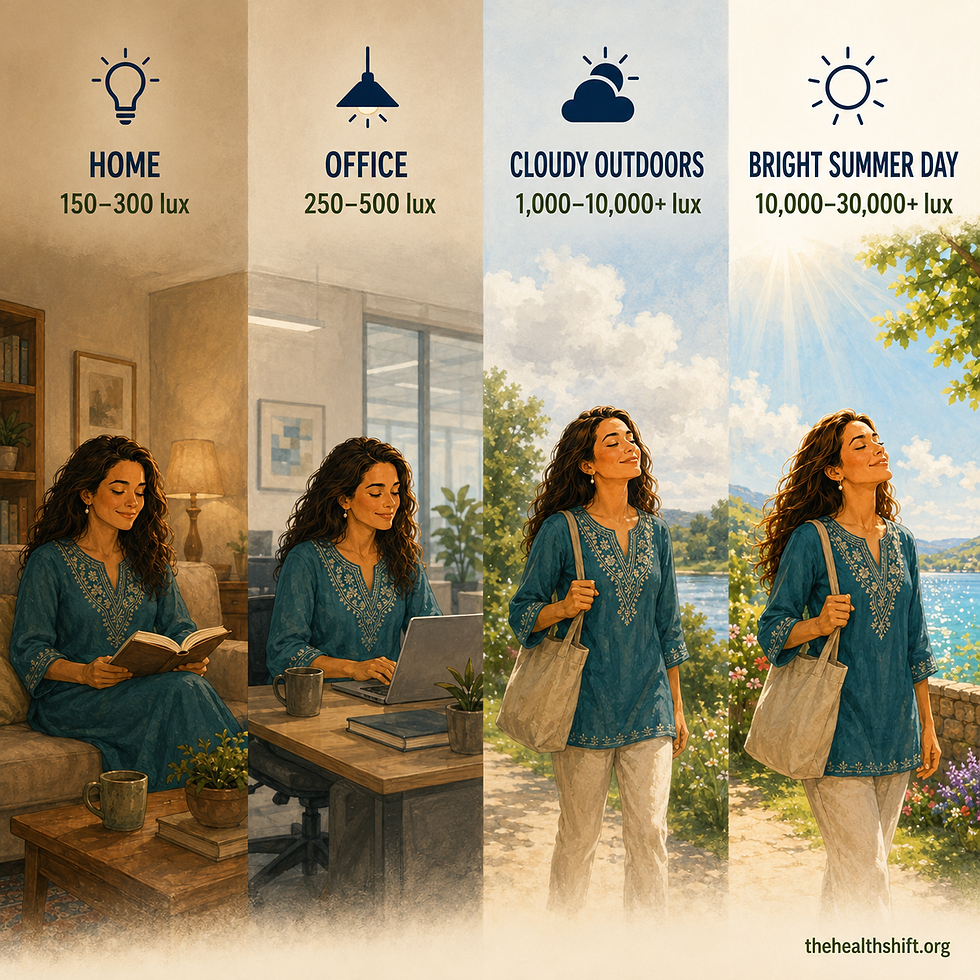
Even a room that feels brightly lit to us is usually much darker than the outdoors. We tend to judge light by whether we can see comfortably. Our circadian system measures it differently. A normally lit home may provide around 150–300 lux, while a well-lit office often reaches approximately 250–500 lux. Outdoors, light levels can easily exceed 10,000–20,000 lux during a summer’s day, with much higher levels possible in direct sunlight. A cloudy morning can still be many times brighter than the room you just left. The exact numbers vary enormously, though the difference in scale is what matters.
How your body knows what time it is
Deep inside the brain sits a small group of cells called the suprachiasmatic nucleus, often described as our central circadian clock. This clock helps coordinate sleep and wakefulness, body temperature, hormone secretion, digestion, alertness and many other processes that change across the day. It generates its own rhythm and uses information from the outside world to remain aligned with the 24-hour day.
Light is its strongest environmental signal. Specialised cells in the retina register light and send this information to the circadian clock. Morning light tells the brain that the active part of the day has begun. Depending on its timing, it can shift the circadian rhythm earlier and help stabilise when we become alert in the morning and sleepy in the evening. This happens gradually; going outside once will rarely transform your sleep that night.
Light also has a direct effect on alertness. During the day, sufficient light supports wakefulness and cognitive performance. Later in the evening, the circadian system begins preparing the body for sleep, with changes that include a rise in melatonin. The timing of morning light influences where this entire rhythm sits. Someone who receives little daylight during the day and plenty of artificial light late at night gives the body a rather blurred picture of when day begins and ends.
Outdoor daylight is especially effective because of its intensity. Opening the curtains is worthwhile, and sitting close to a bright window may provide more light than sitting at the back of a room. Glass, distance from the window, surrounding buildings and the direction of the room all affect how much light actually reaches your eyes. Stepping outdoors usually increases the exposure considerably.
You can explore this yourself with one of the many lux-meter apps available for Apple and Android phones. Depending on the phone, these apps use the light sensor or camera to estimate illumination, so they are less accurate than a professional lux meter. They are accurate enough to reveal the broad contrast. Measure the light beside your breakfast table, then measure it again just outside the door. The size of the difference often makes the idea of “getting morning light” much more tangible.
What if there is no morning light when you wake?
In Belgium and other northern countries, morning light comes with a practical complication. During winter, many people wake at six or seven while dawn may still be well over an hour away. Telling them to get bright outdoor light immediately after waking ignores the season they are actually living in. Standing outside in the dark may provide fresh air and movement, though it cannot provide a daylight signal that has not arrived yet.
A daylight lamp or light-therapy glasses can be useful in these circumstances. A conventional light box is usually placed in front of you while you eat, read or work. Wearable devices, such as AYO glasses, allow you to move around while receiving light. The effective dose depends on the intensity, spectrum, duration, distance and direction of the light, so lux figures from different devices cannot always be compared directly. Following the manufacturer’s instructions matters more than choosing the device with the largest number on the box.
Once natural daylight appears, it still makes sense to go outside if you can. Artificial light can bridge the dark part of a winter morning; outdoor light then strengthens the distinction between day and night. This may be as simple as walking part of the commute, taking a brief outdoor break around nine, or making the first patient-free moment of the morning your cue to step outside.
A small experiment for the coming week
For seven days, go outside within the first hour after waking. Aim for 15–30 minutes outdoors. Use time that already exists: eat breakfast on the terrace or balcony, drink your coffee by the open back door, walk the dog, cycle to work or take a short phone call outside. Breakfast outdoors is particularly efficient because you are already sitting there for ten or twenty minutes; the habit asks for very little extra time.
If you wake before dawn, use a suitable daylight lamp or light-therapy glasses according to their instructions. Add some outdoor daylight later in the morning once it becomes available. Measure the lux in two or three of your usual locations and write down the results.
Allow your eyes to encounter the surrounding light naturally and never look directly at the sun. People with certain medical conditions, retinal or other eye disease, or medication that increases light sensitivity should discuss therapeutic bright-light devices with an appropriate clinician. Shift workers also require more individual timing, because bright light at the wrong point in their sleep–wake schedule can shift their rhythm in an unhelpful direction.
During the experiment, observe four things: how awake you feel during the first part of the morning, your energy levels during the day, when sleepiness begins in the evening, and how easily you get out of bed the following day. You can score each from 0 to 10 or write a few words in your phone. Try to keep your waking time reasonably consistent, since large changes in schedule make it harder to know what the light exposure is doing.
You may notice a difference in your alertness or sleep timing, or you may simply discover how little daylight normally reaches you before noon. Either way, try taking tomorrow’s breakfast outside—or, in a Belgian winter, placing yourself near a daylight lamp until the morning finally appears.
Want to learn more?
If you would like to understand how light, meals, activity and sleep interact with your internal clock, I recommend The Circadian Code by Satchin Panda. You can find out more about it in The Health Shift Library.
Continue your Health Shift
I regularly explore practical ways to better understand and support your health—without rigid rules or health advice overload. Subscribe at the bottom of this page to receive new articles and practical shifts in your inbox.
References and further reading
Brown TM, Brainard GC, Cajochen C, et al. Recommendations for daytime, evening and nighttime indoor light exposure to best support physiology, sleep and wakefulness in healthy adults. PLoS Biology. 2022;20(3):e3001571.
Duffy JF, Czeisler CA. Effect of light on human circadian physiology. Sleep Medicine Clinics. 2009;4(2):165–177. Read the review
Stothart ER, McHill AW, Depner CM, et al. Circadian entrainment to the natural light-dark cycle across seasons and the weekend. Current Biology. 2017;27(4):508–513.
National Institute of General Medical Sciences. Circadian rhythms.


